




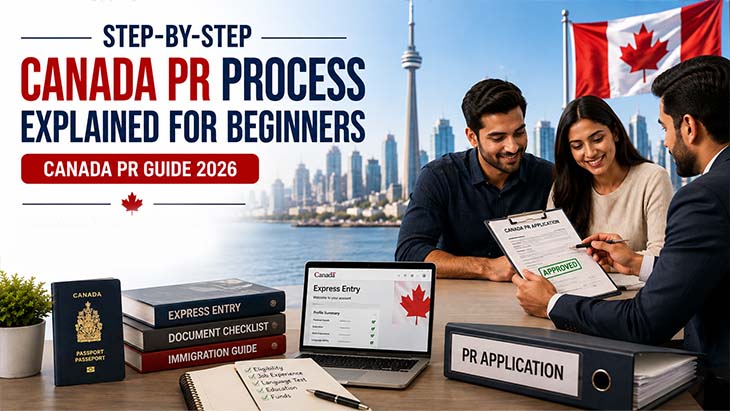

Canada continues to be one of the most preferred destinations for skilled professionals, students, entrepreneurs, and families seeking better career opportunities and an improved quality of life. With its strong economy, excellent healthcare system, world-class education, and multicultural environment, obtaining Canadian Permanent Residency (PR) is a dream for many.
If you're new to immigration and wondering where to start, this beginner-friendly guide explains the complete Canada PR process step by step.
What is Canada Permanent Residency (PR)?
Permanent Residency (PR) allows foreign nationals to live, work, and study anywhere in Canada indefinitely while enjoying many of the same rights as Canadian citizens.
As a PR holder, you can:
- Live and work in any Canadian province
- Access Canada's public healthcare system
- Sponsor eligible family members
- Apply for Canadian citizenship after meeting residency requirements
- Enjoy social benefits and legal protections
Unlike temporary visas, PR provides long-term settlement opportunities.
Step 1: Check Your Eligibility
Before beginning your application, determine whether you're eligible for Canadian immigration.
The most common pathways include:
- Express Entry
- Provincial Nominee Program (PNP)
- Family Sponsorship
- Atlantic Immigration Program
- Rural Community Immigration Programs
- Start-Up Visa Program
- Quebec Immigration Programs
Most skilled professionals apply through Express Entry, Canada's fastest immigration pathway.
Eligibility is generally assessed based on:
- Age
- Education
- Work experience
- English or French language proficiency
- Adaptability
- Job offer (optional in many cases)
Step 2: Calculate Your CRS Score
If you're applying through Express Entry, you'll receive a Comprehensive Ranking System (CRS) score.
The CRS score is based on factors such as:
- Age
- Educational qualifications
- Skilled work experience
- IELTS/CELPIP/French language scores
- Spouse qualifications (if applicable)
- Canadian work experience
- Provincial nomination
- Job offer
A higher CRS score increases your chances of receiving an Invitation to Apply (ITA).
Step 3: Take an Approved Language Test
Language proficiency is a mandatory requirement for most immigration programs.
Accepted English tests include:
- IELTS General Training
- CELPIP General
Accepted French tests include:
- TEF Canada
- TCF Canada
Better language scores can significantly improve your CRS ranking.
Step 4: Obtain an Educational Credential Assessment (ECA)
If your education was completed outside Canada, you'll usually need an Educational Credential Assessment (ECA).
The ECA confirms that your foreign education is equivalent to Canadian educational standards.
Common organizations providing ECA include:
- WES
- IQAS
- CES
- ICAS
- ICES
Without an ECA, your foreign education may not earn CRS points.
Step 5: Gather Required Documents
Preparing your documents early can help avoid delays.
Typical documents include:
- Passport
- Educational certificates
- ECA report
- Language test results
- Employment reference letters
- Salary slips (if required)
- Proof of funds
- Police Clearance Certificate (PCC)
- Medical examination report
- Marriage certificate (if applicable)
- Birth certificates
- Digital photographs
Ensure all documents are valid and accurately translated if necessary.
Step 6: Create Your Express Entry Profile
Once you have your:
- Language test results
- ECA report
- Work experience details
You can create your online Express Entry profile.
You'll enter information about:
- Personal details
- Education
- Work history
- Language scores
- Family information
The system automatically calculates your CRS score.
Step 7: Enter the Express Entry Pool
After submitting your profile, you'll enter the Express Entry pool.
Canada regularly conducts Express Entry draws, inviting candidates with competitive CRS scores.
You may receive an Invitation to Apply (ITA) if your score meets or exceeds the draw cutoff.
If your CRS score is lower, you can improve it by:
- Retaking your language test
- Completing additional education
- Gaining more work experience
- Learning French
- Securing a Provincial Nomination
- Obtaining a valid job offer (where applicable)
Step 8: Receive an Invitation to Apply (ITA)
Receiving an ITA is one of the most important milestones.
Once invited, you'll have a limited period to submit your complete PR application.
Carefully review every document before submission to avoid rejection or delays.
Step 9: Submit Your PR Application
Your application typically includes:
- Identity documents
- Medical examination
- Police certificates
- Proof of work experience
- Proof of funds
- Supporting declarations
Accuracy is extremely important.
Providing incorrect information or incomplete documentation may result in delays or refusal.
Step 10: Biometrics and Medical Examination
Applicants are generally required to:
- Provide fingerprints
- Submit a photograph
- Complete a medical examination through an approved panel physician
Medical exams ensure applicants meet Canada's health requirements.
Step 11: Application Review
Canadian immigration officers verify:
- Documents
- Employment history
- Educational qualifications
- Criminal background
- Medical results
- Security checks
Processing times vary depending on the immigration program and application volume.
Step 12: Receive Confirmation of Permanent Residence (COPR)
If your application is approved, you'll receive:
- Confirmation of Permanent Residence (COPR)
- Permanent Resident Visa (if required)
This allows you to officially immigrate to Canada.
Step 13: Move to Canada
Once you arrive in Canada, you'll complete the landing process.
Your PR Card will be mailed to your Canadian address after arrival.
From this point, you officially become a Canadian Permanent Resident.
Common Reasons for Canada PR Delays
Many applications experience delays because of:
- Missing documents
- Incorrect information
- Expired language test results
- Insufficient proof of funds
- Incomplete employment records
- Medical or background verification delays
Preparing your application carefully can help avoid these issues.
Tips to Improve Your Chances of Canada PR
To maximize your success:
- Aim for higher IELTS or CELPIP scores.
- Complete your Educational Credential Assessment early.
- Keep all employment documents updated.
- Monitor Express Entry draws regularly.
- Explore Provincial Nominee Programs if your CRS score is lower.
- Ensure all submitted information is accurate and truthful.
- Keep your passport and supporting documents valid throughout the process.
Frequently Asked Questions (FAQs)
1. How long does the Canada PR process take?
Processing times vary depending on the immigration program, application completeness, and current processing volumes.
2. Is IELTS mandatory for Canada PR?
Most skilled immigration pathways require proof of language proficiency through approved English or French language tests. Certain programs may have different requirements.
3. What is the minimum CRS score required?
There is no fixed minimum. The required CRS score changes with each Express Entry draw.
4. Can I apply without a job offer?
Yes. Many successful applicants receive PR without having a Canadian job offer, especially through Express Entry.
5. Can my family apply with me?
Yes. Eligible spouses and dependent children can usually be included in your PR application.
Final Thoughts
Applying for Canada Permanent Residency may seem overwhelming at first, but breaking the process into clear, manageable steps makes it much easier. From checking your eligibility and improving your CRS score to submitting a complete application and receiving your Confirmation of Permanent Residence (COPR), every stage plays an important role in your immigration journey.
Careful planning, accurate documentation, and staying informed about the latest immigration requirements can significantly improve your chances of success. Whether you're a skilled professional, a recent graduate, or someone planning a better future for your family, understanding the Canada PR process is the first step toward making your Canadian dream a reality.



Post Comments